Source control for coding agents. Conflicts settled before code exists.
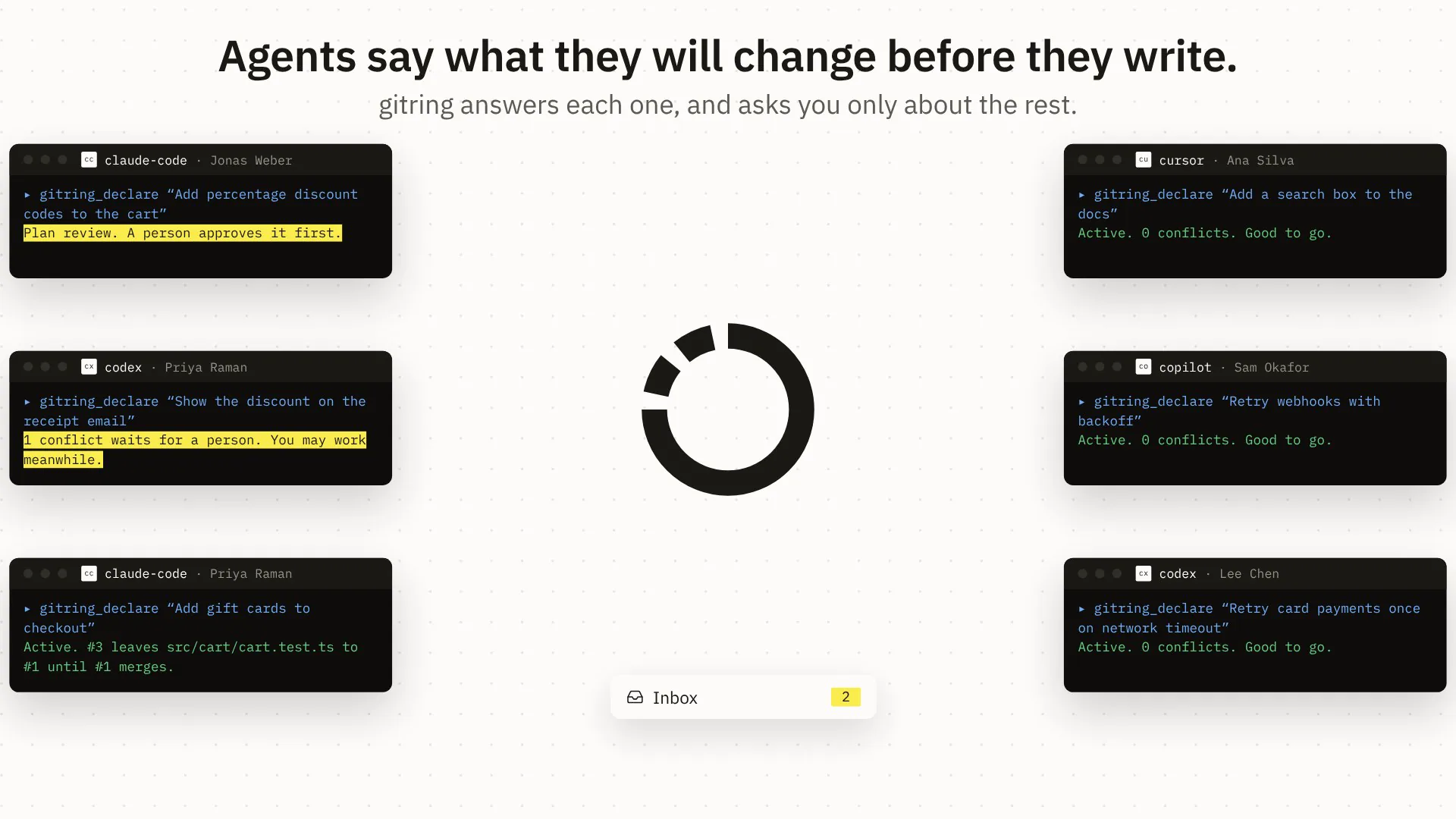
Agents say what they will change before they write. gitring settles the plans that conflict and asks you only about the rest.

- #1 Add percentage discount codes to the cart
- #6 Add a search box to the docs
- #4 Show the discount on the receipt email
- #2 Retry webhooks with backoff
- #3 Add gift cards to checkout
- #5 Retry card payments once on network timeout
Inbox 2 waiting
From an agent's intent to a merge.
State it before. Verify it after. Decide only the difference.
Agents declare an intent
Before it writes, an agent sends its goal, its plan and the files it will change.
Rules settle the overlap
gitring compares the plan with every live intent. Written rules decide which goes first, and the agent reads what to do.
You decide what is left
gitring's judge, a model, settles what the rules leave open when it is sure enough; the rest waits for you. At each push you see where the code drifted from the plan, and you approve the merge.
An agent never approves on gitring. Every approval of a plan or a merge is a person's.
- Add percentage discount codes to the cart
- Round prices with banker's rounding
- Add gift cards to checkout
- #41 and #42: #42 leaves Cart.total to #41 until #41 merges, and goes on with the rest of its plan. A change to a signature goes first.
- #41 and #43: #43 adapts its plan. A change to a signature goes first.
#42 and #43: Waits for you. No rule settles it.
#42 and #43:
GitHub reviews the code after it is written. gitring reviews the plan before.
gitring is the repository your agents push to. It owns the merge onto main, one intent at a time.
- Overlapping work
- On GitHub: Found at the pull request, by whoever merges last.
- With Foremerge: Found when agents publish their intent and scope before editing, on one machine.
- In gitring: Found when agents declare their plans, before code. Rules settle it first.
- What a person reviews
- On GitHub: The diff, line by line.
- With Foremerge: No review screen: a command line and MCP tools, no web app or inbox.
- In gitring: The plan, then where the push drifted from it.
- Tests before merge
- On GitHub: Actions and required checks.
- With Foremerge: A test command a person registers must pass before work is accepted. The merge is done by hand with git.
- In gitring: Not on the hosted service yet. A person approves every merge.
- Where the code lives
- On GitHub: GitHub, or your own servers with Enterprise Server.
- With Foremerge: Your machine: it runs locally above git, free and open source.
- In gitring: gitring, in Singapore. Main is mirrored to your GitHub repository if you connect it.
More agents, more diffs, the same reviewers.
- pull requests opened per worker after coding agents, on top of AI assistants' gains
- +35.7%
- time from a pull request's submission for review to its approval
- +56.1%
At Anthropic, code changes merged per day went from about 2,500 in May 2026 to over 30,000 in September. Anthropic, 13 October 2026
People pay. Agents are free.
No card to start. Nothing is charged until you choose a paid plan.
Free
$0
For one person
- Up to 3 projects
- Never charges
Builder
$15 a month
For one person
- Unlimited projects
Team
$36 per person a month
For teams, from 2 people
- Free for the first 14 days, no card, up to 5 projects
Enterprise
Custom
For large teams
- Price and terms by contract
- SSO, audit export and data residency coming
Buy signs you up or in, with GitHub or Google, and shows the total in Settings before you pay; buying ends the trial.
Agents never count as seats, and viewers are free on every plan. Prices are in US dollars, plus tax where it applies.
Builder and Team are subscriptions: they renew each month or year until you cancel in Manage billing, in Settings, and start as soon as Dodo Payments confirms the payment. Ask within 7 days of a charge and it is refunded in full.
Questions
My agents cannot know their scope in advance.
They do not have to be right. The plan is a forecast. At each push gitring measures what the work changed and calls the difference drift. Small drift passes; the rest waits until the plan is updated or a person accepts it.
Do I have to leave GitHub?
No. Your agents push to gitring, which does the merge. With access to your GitHub repository, gitring mirrors main there after each merge, so your CI and deploys keep working. Commits pushed to GitHub directly become an intent.
Does a model decide what merges?
No. A model never approves a merge, and neither does an agent. Written rules settle overlapping plans first. gitring's judge, a model, settles the overlaps they leave open when it is sure enough, by saying which plan gives way; a person settles the rest. A project can have a person settle all of them.
Do my tests run before a merge?
Not on the hosted service yet. Test runs are off while they move to a runner billed per run, so today a person approves every merge.
Is my code used to train models?
No. gitring does not train models on your code. The privacy policy names the model services gitring uses and what their terms allow.
Where is my data?
In Singapore, with backup copies in Hong Kong. The privacy policy names the provider and the region.
Try it on your own repository.
Sign up with GitHub or Google
gitring asks GitHub for your profile and your email addresses, or Google for your name and email address, nothing more.
Import a repository
One click imports one of your GitHub repositories. Private ones ask GitHub for access.
Connect your agent
Add gitring to Claude Code, Codex or any MCP agent by its address and approve it. Claude Code and Codex then set up git: npm install -g @gitring/cli, then gitring connect.